In my 18 years of clinical practice as a trichologist and cosmetologist, very few natural ingredients have impressed me as consistently as tea tree benefits.
Patients come to me with acne, oily skin, dandruff, itchy scalps, dark spots, and skin infections — and time and again, tea tree oil appears as part of the solution. The benefits of tea tree oil are not just anecdotal or based on trends. They are backed by decades of scientific research and clinical use across the world.
But here is the problem: most people either use it incorrectly — applying it directly without dilution and burning their skin — or they use too little and see no results. Some dismiss it entirely because they tried it once, the wrong way.
In this complete guide, I am going to share everything you need to know about tea tree oil benefits for skin, hair, and health. How it works, what conditions it helps with, how to use it safely, and what to realistically expect. This is the guide I wish every one of my patients could read before they open the bottle.
What Is Tea Tree Oil?
Tea tree oil is a natural essential oil extracted from the leaves of Melaleuca alternifolia — a plant native to Australia. It has been used for centuries by the Aboriginal people of Australia for its powerful healing properties, long before modern science confirmed what they already knew.
The oil is extracted through steam distillation of the leaves and twigs of the plant. The result is a pale yellow, sometimes almost clear oil with a distinctive camphor-like scent. Its active compound — terpinen-4-ol — is what gives tea tree oil its remarkable antibacterial, antifungal, and anti-inflammatory properties.
Today, tea tree oil is used in hundreds of skincare, haircare, and medicinal products worldwide. And the reason is simple: it works — when used the right way.
The Science Behind Tea Tree Oil — Why It Works
As a doctor, I always want to know why something works before I recommend it. Here is the science behind the tea tree benefits you will hear about throughout this article:
Multiple published studies in journals like the Medical Journal of Australia and the International Journal of Dermatology have confirmed that tea tree oil is as effective as benzoyl peroxide for mild to moderate acne — but with significantly fewer side effects like dryness and irritation.
Top Tea Tree Benefits for Skin
This is where the majority of my patients see results. The tea tree oil benefits for skin are wide-ranging — from treating active breakouts to calming sensitive, reactive skin.
Tea Tree Oil Benefits for Acne and Pimples
Acne is one of the most common reasons people discover tea tree oil. And the science genuinely supports its use. Tea tree oil for pimples works through multiple mechanisms:
How Tea Tree Oil Helps Treat Acne
Kills Acne Bacteria
Tea tree oil’s primary active compound, terpinen-4-ol, penetrates the skin and kills Cutibacterium acnes — the bacteria responsible for inflamed pimples and cystic acne. It does this without the harsh drying effects often associated with benzoyl peroxide.
Reduces Inflammation
Beyond killing bacteria, tea tree oil helps calm irritated skin by reducing redness and swelling around active pimples. This soothing effect allows blemishes to flatten and fade faster compared with untreated breakouts.
Prevents New Breakouts
When used regularly as part of a skincare routine, tea tree oil’s antibacterial properties help keep bacterial growth on the skin under control. This reduces the likelihood of clogged pores turning into new pimples and breakouts.
How to use it for acne: Dilute 1 drop of tea tree oil in 1 teaspoon of a light carrier oil like jojoba or aloe vera gel. Apply directly to the pimple using a clean cotton bud. Do not apply to the entire face undiluted.
For mild to moderate acne, tea tree oil can be as effective as many over-the-counter treatments — but it requires patience. Use it consistently for at least 4 to 6 weeks before evaluating the results, as natural ingredients often work gradually while being gentler on the skin.
Tea Tree Oil Benefits for Oily Skin
One of the most underrated tea tree oil uses and benefits is its ability to regulate sebum — the natural oil your skin produces. For people with oily skin, excess sebum leads to shiny skin, enlarged pores, and frequent breakouts.
Tea tree oil helps by:
- Reducing excess oil production on the skin surface
- Keeping pores clearer and less congested
- Preventing the bacterial overgrowth that excess oil encourages
- Leaving a mattified, balanced finish without over-drying the skin
Unlike harsh astringents that strip all oil and cause rebound greasiness, tea tree oil balances — not strips — which is why the results last longer.
For oily skin, I recommend adding 2 drops of diluted tea tree oil to your usual lightweight moisturiser rather than using it as a standalone step. This allows the entire face to benefit from tea tree oil’s antibacterial properties while avoiding concentration issues or irritation.
Tea Tree Oil for Dark Spots and Uneven Skin Tone
Tea tree oil for dark spots works indirectly but effectively. It does not bleach the skin — instead, it addresses the root causes of post-acne marks and hyperpigmentation:
- By clearing active acne faster, it prevents the deep inflammation that creates dark spots
- Its anti-inflammatory properties reduce the redness and early pigmentation after a pimple heals
- Its antioxidant activity helps protect skin cells from the oxidative stress that worsens pigmentation
For existing dark spots, tea tree oil works best when used alongside a dedicated brightening ingredient like Vitamin C or Niacinamide. On its own, it prevents new spots from forming more than it fades existing ones.
Tea Tree Oil for Skin Infections and Wounds
This is one of the oldest documented tea tree oil advantages for skin — its use as a natural antiseptic. Before antibiotics became widely available, tea tree oil was used in first-aid kits for cuts, insect bites, minor burns, and skin infections.
Today, clinical evidence supports its use for:
- Minor cuts and abrasions — prevents bacterial infection
- Insect bites — reduces itching, swelling, and the risk of secondary infection
- Folliculitis (infected hair follicles) — one of the conditions I treat regularly in my clinic
- Fungal skin infections like tinea and athlete’s foot
Important: For serious or deep wounds, infections with fever, or conditions that are spreading, please see a doctor. Tea tree oil is for minor, surface-level skin issues — not a replacement for medical treatment.
Tea Tree Oil Benefits for Hair and Scalp Health
As a trichologist — a specialist in hair and scalp health — this section is particularly close to my area of expertise. The tea tree oil benefits for hair are among the most clinically validated uses of this ingredient.
Tea Tree Oil for Dandruff
Dandruff is one of the most common complaints I hear in my clinic. And tea tree oil for dandruff is one of the most effective natural interventions available. Here is why:
The most common cause of dandruff is an overgrowth of a yeast-like fungus called Malassezia on the scalp. This fungus feeds on scalp oils and produces irritating byproducts that cause the scalp to shed skin cells faster than normal — creating the white or yellowish flakes we recognise as dandruff.
Tea tree oil’s antifungal properties directly target Malassezia. A landmark study published in the Journal of the American Academy of Dermatology found that a 5% tea tree oil shampoo significantly reduced dandruff severity after just 4 weeks of use.
How to use it for dandruff: Add 5 to 6 drops of tea tree oil to your regular shampoo, or mix it with a tablespoon of coconut oil and massage it into the scalp 30 minutes before washing. Use 2 to 3 times a week.
Consistency is everything when treating dandruff. Tea tree oil works best as a maintenance treatment — continue using it regularly even after dandruff clears to help keep the scalp balanced and prevent flakes from returning.
Tea Tree Oil for Itchy Scalp
An itchy scalp can have several causes — dandruff, product build-up, dryness, scalp psoriasis, or seborrheic dermatitis. Tea tree oil addresses several of these simultaneously:
- Its antifungal action reduces the Malassezia overgrowth that causes scalp itching
- Its anti-inflammatory properties soothe the irritated scalp skin
- Its antiseptic properties clear product residue and bacterial build-up on the scalp
For patients with chronic scalp itching from seborrheic dermatitis, I often incorporate tea tree oil into their treatment protocol alongside medicated options.
Tea Tree Oil for Hair Growth
Tea tree oil does not directly stimulate hair follicles the way certain medical treatments do. However, it creates the optimal scalp environment for healthy hair growth — and that is just as important.
A healthy scalp with clear, unclogged follicles, balanced sebum levels, and no inflammation supports stronger, thicker hair growth. Tea tree oil contributes by:
- Unclogging hair follicles that are blocked by excess sebum and dead skin cells
- Reducing scalp inflammation that can impair follicle function
- Improving scalp circulation through massage application
- Maintaining a clean, balanced scalp environment that supports the hair growth cycle
For hair growth concerns, tea tree oil works best when used during a scalp massage with a nourishing carrier oil such as coconut oil or castor oil. The massage itself helps stimulate blood circulation to the hair follicles, while tea tree oil supports a healthier scalp environment and enhances the overall effectiveness of the treatment.
Antibacterial and Antifungal Benefits of Tea Tree Oil
Beyond skincare and haircare, the broader medicinal benefits of tea tree oil deserve their own section. Its antiseptic and antifungal benefits make it one of the most versatile natural ingredients available.
What makes the antibacterial properties of tea tree oil so clinically useful is that it works against a broad spectrum of bacteria — including some antibiotic-resistant strains — without promoting the antibiotic resistance that is a growing concern in modern medicine.
How to Use Tea Tree Oil Safely
This is the section most people skip — and it is the reason so many people have a bad experience with tea tree oil. The most important rule is this:
⚠️ NEVER apply undiluted tea tree oil directly to large areas of skin.
Undiluted tea tree oil is a potent essential oil. Applied directly to skin without dilution, it can cause redness, burning, irritation, and chemical burns — especially on sensitive skin. The only exception is a single drop applied with a cotton bud directly to an isolated pimple.
Dilution Guide
Here is the dilution guide I share with my patients:
Step-by-Step: How to Apply Tea Tree Oil for Acne
- Wash your face with a gentle cleanser and pat dry.
- Mix 1 drop of tea tree oil with 1 teaspoon of aloe vera gel or jojoba oil.
- Using a clean cotton bud, apply directly to the pimple only.
- Leave on — do not rinse.
- Follow with your regular moisturiser.
- Repeat once or twice daily.
Consider to read: How to Treat Acne Naturally: 12 Proven Home Remedies for Clear Skin
Step-by-Step: How to Use Tea Tree Oil for the Scalp
- Mix 5 to 6 drops of tea tree oil into 1 tablespoon of warm coconut oil.
- Part your hair and apply to the scalp in sections.
- Massage gently for 2 to 3 minutes to boost circulation.
- Leave on for 30 minutes to 1 hour.
- Wash out with a gentle, sulfate-free shampoo.
- Use 2 to 3 times a week for dandruff or itchy scalp.
Safety Precautions
- Patch test first — Before using on your face or scalp, apply diluted tea tree oil to your inner wrist and wait 24 hours. If there is no redness or irritation, it is safe to proceed.
- Never ingest tea tree oil — It is toxic when swallowed. Keep it away from children.
- Avoid the eye area — Keep away from eyes and mucous membranes.
- Use during pregnancy with caution — Consult your doctor before using essential oils during pregnancy.
- Store correctly — Keep in a cool, dark place away from direct sunlight to preserve potency.
If you experience burning, redness, or irritation after using tea tree oil — even when diluted — stop using it immediately and rinse the area thoroughly with water. Some individuals may have an allergic reaction to tea tree oil regardless of dilution. Always perform a patch test on a small area of skin before regular use.
Common Mistakes People Make With Tea Tree Oil
In my clinic, I see the same mistakes repeatedly. Here is what to avoid:
- Using it undiluted on the whole face — The most common and most damaging mistake. Always dilute, always patch test.
- Expecting overnight results — Tea tree oil for acne works over 4 to 6 weeks of consistent use. It is not an overnight cure.
- Overusing it — Applying it multiple times a day does not speed up results — it irritates skin and disrupts the skin barrier. Once or twice daily is sufficient.
- Using poor quality or adulterated oil — Always choose 100% pure tea tree oil from a reputable brand. Cheaper blended oils often lack the therapeutic concentration needed to be effective.
- Applying it to broken or raw skin — Avoid applying to open wounds, raw acne, or inflamed cystic acne. This can cause burning and worsen inflammation.
- Not moisturising afterwards — Tea tree oil can be drying. Always follow with a good moisturiser to keep the skin barrier intact.
Recommended Tea Tree Products From Dr Sufis Wellness
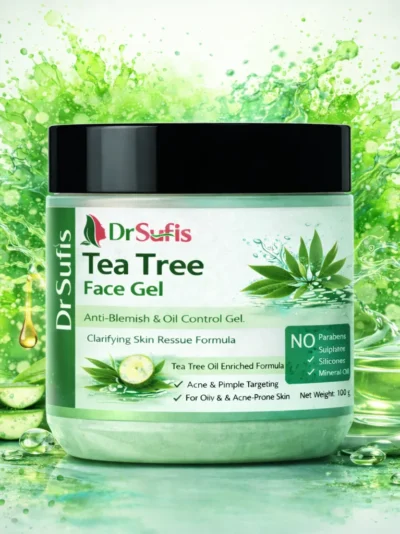
When incorporating tea tree oil into your routine, the quality of the formulation matters enormously. At Dr Sufis Wellness, our products are formulated with the therapeutic concentration of tea tree oil needed to deliver real results — without the irritation risk of using raw essential oil incorrectly.
Our Tea Tree Face Wash delivers the antibacterial benefits of tea tree oil in a gentle, pH-balanced formula suitable for daily use on acne-prone and oily skin.
For scalp health, incorporating tea tree oil into a nourishing scalp massage using our products creates the ideal environment for dandruff control and healthy hair growth.
Ready-formulated tea tree products are generally safer and more consistent than DIY essential oil dilutions — especially for beginners. In professionally formulated skincare or haircare products, the concentration of tea tree oil is carefully calibrated so you can receive the antibacterial and soothing benefits without the risk of irritation or incorrect dilution.
Frequently Asked Questions About Tea Tree Benefits
Here are the most commonly searched questions I hear from patients and readers:.
1. What are the main benefits of tea tree oil for skin?
2. Can I apply tea tree oil directly to my face?
3. How do I dilute tea tree oil for skin use?
4. Does tea tree oil really work for acne?
5. Is tea tree oil good for dandruff?
6. Can tea tree oil help with hair growth?
7. How often should I use tea tree oil on my skin?
8. Is tea tree oil safe for sensitive skin?
9. Can tea tree oil fade dark spots?
10. What should I never do with tea tree oil?
Final Words From Dr. Sufia Shaikh
Tea tree oil has earned its place in clinical skincare and haircare — not because of marketing, but because of measurable, reproducible results backed by real science.
After 18 years of treating patients with acne, oily skin, dandruff, scalp conditions, and skin infections, I continue to recommend tea tree oil as part of evidence-based treatment plans. The benefits of tea tree oil are real. The results are achievable. But they require the right approach.
Use it diluted. Use it consistently. Give it time. And pair it with a simple, complete skincare or haircare routine that supports your skin’s natural balance.
If you are unsure how to incorporate tea tree oil into your specific routine, or if your skin concern is more complex, a consultation with a qualified cosmetologist or trichologist will always point you in the right direction.
Your skin and hair deserve care that is rooted in science, not just trends. Tea tree oil, used correctly, is exactly that.
Nature gave us powerful tools. Tea tree oil is one of them. Science confirmed it. Eighteen years of patient results convinced me. Use it right — and it will not let you down.